
Understanding interest rate formulas is essential for solving financial mathematics problems related to savings, loans, investments, salary growth, and population models. This formula table provides a quick summary of important concepts including simple interest, compound interest, monthly deposits, loan repayments, and exponential growth formulas, helping students and learners calculate financial values more efficiently.
Customers deposit money into bank A with simple interest r / year. The money a customer receives after n years is:
$S = A(1 + nr)$
2. COMPOUND INTEREST
Customers deposit money into bank A with compound interest r / year. The money a customer receives after n years is:
$S = A(1 + r)^n$
3. MONTHLY DEPOSIT
At the beginning of each month, customers deposit money into bank A with compound interest r / month. The total principal and interest after n months (including the final month’s deposit when the money is made into the bank) is:
$S = \dfrac{A}{r} \cdot \left[(1+r)^n -1\right] \cdot (1+r)$
4. MONTHLY DEPOSIT AND WITHDRAWAL
Customers deposit money into bank A with compound interest r / month.
At the beginning of each month, deposit A and withdraw X.
The balance after n months is:
$S_n = A(1+r)^n - X \cdot \dfrac{(1+r)^n -1}{r}$
5. LOAN WITH MONTHLY REPAYMENT
Borrow money from bank A with interest r / month.
After 1 month, start the full repayment, equal payments every month for 1 month, total X payments, final balance after n payments is:
$0 = A(1+r)^n - X \cdot \dfrac{(1+r)^n -1}{r}$
$X = \dfrac{A \cdot r(1+r)^n}{(1+r)^n -1}$
6. INCREASE IN SALARY
A person has an initial salary A dollars / month.
If after x months, the salary increases by r.
After n months, how much salary does that person receive in total?
$S = A \cdot x \cdot \dfrac{(1+r)^k -1}{r}$
$k = \dfrac{n}{x}$
7. POPULATION GROWTH
$S = A \cdot e^{nr}$
Note:
r is written in decimal form, e.g. $5% = 0.05$.
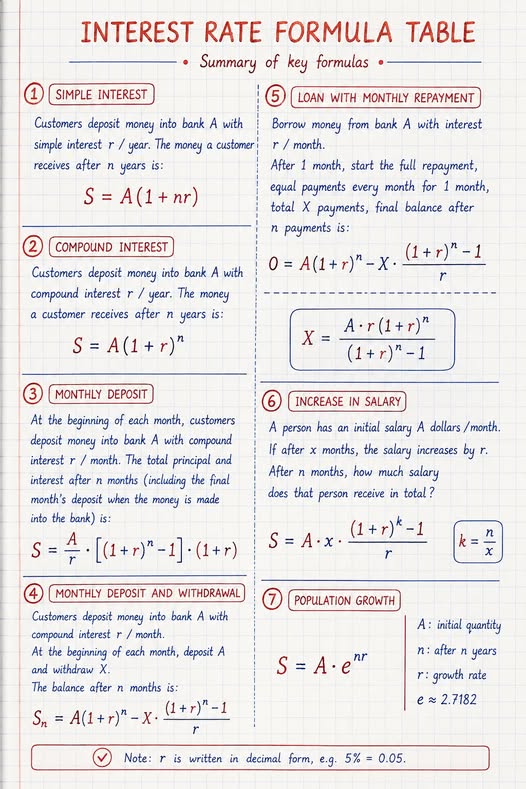
1. SIMPLE INTERESTCustomers deposit money into bank A with simple interest r / year. The money a customer receives after n years is:
$S = A(1 + nr)$
2. COMPOUND INTEREST
Customers deposit money into bank A with compound interest r / year. The money a customer receives after n years is:
$S = A(1 + r)^n$
3. MONTHLY DEPOSIT
At the beginning of each month, customers deposit money into bank A with compound interest r / month. The total principal and interest after n months (including the final month’s deposit when the money is made into the bank) is:
$S = \dfrac{A}{r} \cdot \left[(1+r)^n -1\right] \cdot (1+r)$
4. MONTHLY DEPOSIT AND WITHDRAWAL
Customers deposit money into bank A with compound interest r / month.
At the beginning of each month, deposit A and withdraw X.
The balance after n months is:
$S_n = A(1+r)^n - X \cdot \dfrac{(1+r)^n -1}{r}$
5. LOAN WITH MONTHLY REPAYMENT
Borrow money from bank A with interest r / month.
After 1 month, start the full repayment, equal payments every month for 1 month, total X payments, final balance after n payments is:
$0 = A(1+r)^n - X \cdot \dfrac{(1+r)^n -1}{r}$
$X = \dfrac{A \cdot r(1+r)^n}{(1+r)^n -1}$
6. INCREASE IN SALARY
A person has an initial salary A dollars / month.
If after x months, the salary increases by r.
After n months, how much salary does that person receive in total?
$S = A \cdot x \cdot \dfrac{(1+r)^k -1}{r}$
$k = \dfrac{n}{x}$
7. POPULATION GROWTH
$S = A \cdot e^{nr}$
- A: initial quantity
- n: after n years
- r: growth rate
Note:
r is written in decimal form, e.g. $5% = 0.05$.
Last edited: