
The 30-60-90 triangle is one of the most important special right triangles in geometry. Because of its predictable side ratios and simple relationships, it appears frequently in algebra, trigonometry, engineering, architecture, and competitive mathematics.
Unlike ordinary triangles, a 30-60-90 triangle has fixed angle measures and a consistent side ratio that allows students to solve problems quickly without always using the Pythagorean Theorem.
In this guide, you will learn:
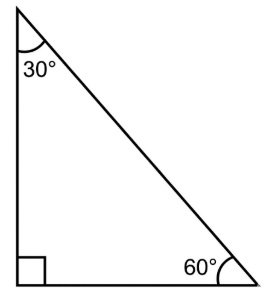
The most important feature of this triangle is its fixed side ratio: $1:\sqrt{3}:2$
This means:
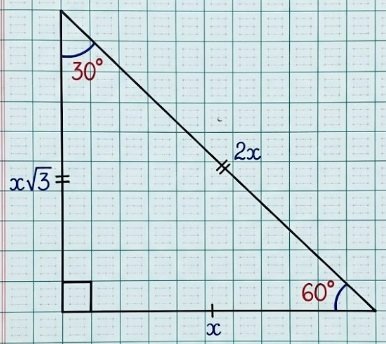 Where:
Suppose an equilateral triangle has side length: $2x$
Since all sides are equal, drawing an altitude splits the triangle into two congruent right triangles.
The altitude creates:
we find the altitude:
then:
Then: $x=12$
Hypotenuse: $24$
For a 30-60-90 triangle:
$\text{Area}=\frac{1}{2}\times x\times x\sqrt{3}$
$\text{Area}=\frac{x^2\sqrt{3}}{2}$
Simplify: $3x+x\sqrt{3}$
So the perimeter formula is: $P=3x+x\sqrt{3}$
Longer leg: $7\sqrt{3}$
Hypotenuse: $14$
Find the other sides.
Longer leg: $10\sqrt{3}$
Find the remaining sides.
Hypotenuse: $30$
By understanding the ratio: $1:\sqrt{3}:2$
students can quickly determine unknown side lengths without lengthy calculations.
Whether you are learning geometry, studying trigonometry, preparing for exams, or solving engineering problems, mastering the 30-60-90 triangle is an essential mathematical skill.
Unlike ordinary triangles, a 30-60-90 triangle has fixed angle measures and a consistent side ratio that allows students to solve problems quickly without always using the Pythagorean Theorem.
In this guide, you will learn:
- What a 30-60-90 triangle is
- The side ratio formula
- How the triangle is formed
- Important properties and rules
- How to solve missing sides
- Area and perimeter formulas
- Real-life applications
- Solved examples and practice problems
What Is a 30-60-90 Triangle?
A 30-60-90 triangle is a special right triangle with angles measuring:- $30^\circ$
- $60^\circ$
- $90^\circ$
The most important feature of this triangle is its fixed side ratio: $1:\sqrt{3}:2$
This means:
- the side opposite $30^\circ$ is the shortest side,
- the side opposite $60^\circ$ is the longer leg,
- the side opposite $90^\circ$ is the hypotenuse.
Side Ratio of a 30-60-90 Triangle
The side lengths always follow this pattern: $x:x\sqrt{3}:2x$- $x$ = shortest side
- $x\sqrt{3}$ = longer leg
- $2x$ = hypotenuse
Why Does the Ratio Work?
The 30-60-90 triangle comes from cutting an equilateral triangle in half.Suppose an equilateral triangle has side length: $2x$
Since all sides are equal, drawing an altitude splits the triangle into two congruent right triangles.
The altitude creates:
- one angle of $30^\circ$,
- one angle of $60^\circ$,
- one angle of $90^\circ$.
we find the altitude:
- $x^2+h^2=(2x)^2$
- $x^2+h^2=4x^2$
- $h^2=3x^2$
- $h=x\sqrt{3}$
Properties of a 30-60-90 Triangle
1. It Is a Right Triangle
One angle always measures: $90^\circ$2. The Hypotenuse Is Twice the Shortest Side
If the shortest side is: $x$ then the hypotenuse is: $2x$3. The Longer Leg Contains $\sqrt{3}$
The side opposite the $60^\circ$ angle equals: $x\sqrt{3}$4. The Angles Always Stay the Same
Every 30-60-90 triangle contains:- one $30^\circ$ angle,
- one $60^\circ$ angle,
- one $90^\circ$ angle.
5. It Is a Special Right Triangle
Together with the $45^\circ-45^\circ-90^\circ$ triangle, it is one of the two most common special right triangles in geometry.How to Solve a 30-60-90 Triangle
Case 1: Given the Shortest Side
If the shortest side equals: $x$then:
- longer leg $=x\sqrt{3}$
- hypotenuse $=2x$
Example
If the shortest side is: $5$ then:- Longer leg: $5\sqrt{3}$
- Hypotenuse: $10$
Case 2: Given the Hypotenuse
If the hypotenuse equals: $2x$ then: $x=\frac{\text{hypotenuse}}{2}$Example
If the hypotenuse is: $18$ then:- Shortest side: $\frac{18}{2}=9$
- Longer leg: $9\sqrt{3}$
Case 3: Given the Longer Leg
If the longer leg equals: $x\sqrt{3}$ then: $x=\frac{\text{longer leg}}{\sqrt{3}}$Example
Suppose the longer leg is: $12\sqrt{3}$Then: $x=12$
Hypotenuse: $24$
Area of a 30-60-90 Triangle
The area formula for a triangle is: $\text{Area}=\frac{1}{2}\times \text{base}\times \text{height}$For a 30-60-90 triangle:
- base $=x$
- height $=x\sqrt{3}$
$\text{Area}=\frac{1}{2}\times x\times x\sqrt{3}$
$\text{Area}=\frac{x^2\sqrt{3}}{2}$
Perimeter of a 30-60-90 Triangle
Add all three sides: $x+x\sqrt{3}+2x$Simplify: $3x+x\sqrt{3}$
So the perimeter formula is: $P=3x+x\sqrt{3}$
Solved Examples
Example 1
Find the missing sides if the shortest side is: $7$Solution
Using the ratio: $x:x\sqrt{3}:2x$Longer leg: $7\sqrt{3}$
Hypotenuse: $14$
Example 2
A 30-60-90 triangle has hypotenuse: $20$Find the other sides.
Solution
Shortest side: $\frac{20}{2}=10$Longer leg: $10\sqrt{3}$
Example 3
The longer leg equals: $15\sqrt{3}$Find the remaining sides.
Solution
Shortest side: $15$Hypotenuse: $30$
Common Mistakes Students Make
Confusing the Side Opposite $30^\circ$
The side opposite $30^\circ$ is always the shortest side.Forgetting the Ratio
Remember the order: $1:\sqrt{3}:2$ not: $1:2:\sqrt{3}$Mixing Up the Hypotenuse
The hypotenuse is always:- opposite the $90^\circ$ angle,
- the longest side.
Final Thoughts
The 30-60-90 triangle is one of the most useful geometric figures in mathematics. Its predictable side relationships make solving right-triangle problems much faster and easier.By understanding the ratio: $1:\sqrt{3}:2$
students can quickly determine unknown side lengths without lengthy calculations.
Whether you are learning geometry, studying trigonometry, preparing for exams, or solving engineering problems, mastering the 30-60-90 triangle is an essential mathematical skill.
Last edited:
Relate Threads